STRUCTURE, KEY BENEFITS, AND COMPARISON OF SMART MULTI-SETPOINT PRESSURE REDUCING VALVES
Discover how Smart Multi-Setpoint Pressure Reducing Valves optimize water pressure, reduce non-revenue water (NRW), protect pipeline infrastructure, and seamlessly integrate with SCADA and IoT systems. Learn more from Sai Gon Valve.
I. STRUCTURE OF A SMART MULTI-SETPOINT PRESSURE REDUCING VALVE
A Smart Multi-Setpoint Pressure Reducing Valve (PRV) is much more than a conventional hydraulic valve. It combines advanced mechanical engineering with industrial automation, intelligent control, and digital communication technologies. This integration enables the valve to automatically regulate downstream pressure based on multiple operating conditions while maintaining system stability and efficiency.
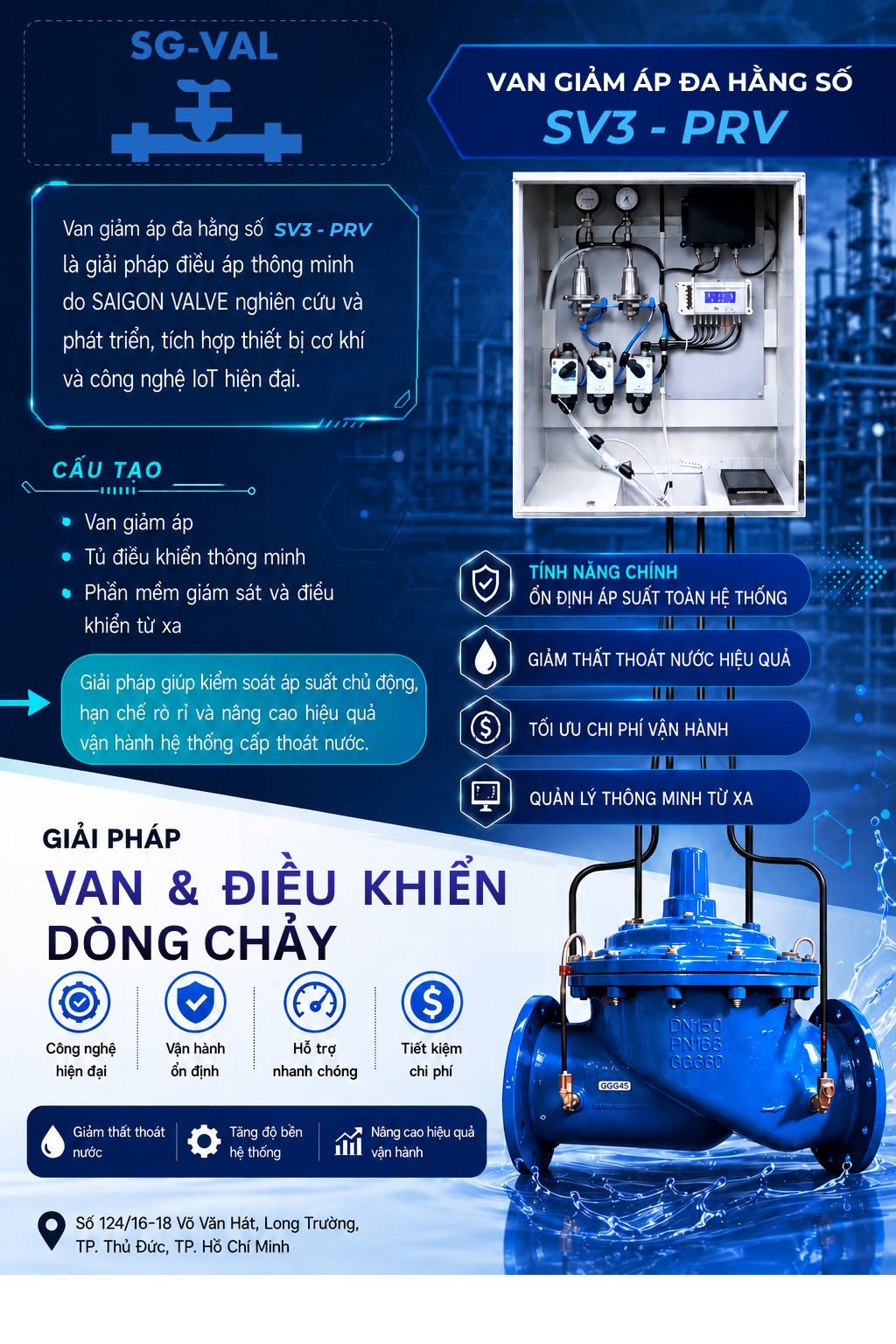
A complete Smart Multi-Setpoint PRV system typically consists of the following major components:
1. Main Valve
The main valve is the primary pressure-bearing component of the entire system. It is commonly manufactured from high-strength materials such as:
Ductile Iron (GJS500-7 / FCD450)
Carbon Steel
Stainless Steel (SS304 or SS316 for corrosive environments)
Depending on the application, the valve is designed with either a diaphragm-type or piston-type construction to ensure stable pressure regulation under continuously changing flow conditions.
For potable water applications, both the internal and external surfaces are typically coated with fusion-bonded epoxy in compliance with international drinking water standards, providing excellent corrosion resistance and extended service life.
2. Pressure Pilot Assembly
The pilot assembly functions as the hydraulic "brain" of the pressure reducing valve.
Its primary functions include:
Monitoring downstream pressure
Comparing actual pressure with the desired pressure setting
Controlling the pressure inside the control chamber
Regulating the opening position of the main valve
Even in intelligent systems, the pilot valve remains an essential safety component because it allows the valve to continue basic pressure regulation even if electrical control or communication is temporarily unavailable.
This hydraulic backup capability offers a significant advantage over fully electronic pressure control systems.
3. Pressure Sensors
Pressure transmitters continuously monitor both upstream and downstream pressures throughout system operation.
Typical monitored parameters include:
Inlet pressure
Outlet pressure
Pressure fluctuations
Pressure variation trends over time
These measurements are transmitted to the controller in real time, allowing precise and responsive pressure regulation.
4. Flow Meter
In modern District Metered Areas (DMA) and Smart Water applications, Smart Multi-Setpoint PRVs are often integrated with electromagnetic or ultrasonic flow meters.
Flow measurement provides valuable operational information, including:
Peak demand identification
Off-peak operation
Abnormal flow detection
Leakage analysis
Demand-based pressure optimization
By combining flow and pressure data, the system can optimize pressure management according to actual network demand rather than relying solely on fixed schedules.
5. PLC / RTU Controller
The Programmable Logic Controller (PLC) or Remote Terminal Unit (RTU) serves as the central processing unit of the system.
Its responsibilities include:
Collecting sensor data
Comparing measured values with predefined pressure setpoints
Executing pressure control algorithms
Sending commands to the actuator
Recording historical operating data
Communicating with the SCADA system
For large municipal water projects, one PLC can simultaneously manage multiple pressure reducing valves across several District Metered Areas.
6. Electric Actuator
Once the controller determines the required valve position, commands are transmitted to the electric actuator.
The actuator performs one of the following actions:
Increase valve opening
Reduce valve opening
Maintain the current valve position
Unlike simple ON/OFF actuators, modulating electric actuators provide continuous proportional control, enabling smooth and precise pressure regulation while minimizing hydraulic shock.
7. Industrial Communication System
One of the most valuable features of Smart Multi-Setpoint PRVs is their compatibility with various industrial communication protocols, including:
Modbus RTU
Modbus TCP/IP
Ethernet/IP
Profibus
MQTT
OPC UA
4–20 mA Analog Signals
RS485
These communication options enable seamless integration with SCADA platforms, Building Management Systems (BMS), Industrial IoT platforms, and other supervisory control systems.
II. HOW DOES MULTI-SETPOINT PRESSURE CONTROL WORK?
The defining feature of a Smart Multi-Setpoint Pressure Reducing Valve is its ability to store and automatically switch between multiple outlet pressure setpoints.
For example:
Operating Time | Outlet Pressure |
|---|---|
00:00 – 05:00 | 2.5 bar |
05:00 – 08:00 | 4.2 bar |
08:00 – 17:00 | 3.6 bar |
17:00 – 22:00 | 4.5 bar |
22:00 – 24:00 | 2.8 bar |
At each scheduled time interval, the controller automatically changes the target outlet pressure without requiring any manual adjustment.
Beyond time-based scheduling, pressure regulation can also be triggered by:
Real-time flow rate
Reservoir water level
Inlet pressure
Pump operating status
Leakage detection signals
SCADA commands
Artificial intelligence (AI) algorithms
Predictive optimization strategies
This dynamic control capability ensures that the water distribution system always operates at the most efficient pressure for current network conditions.
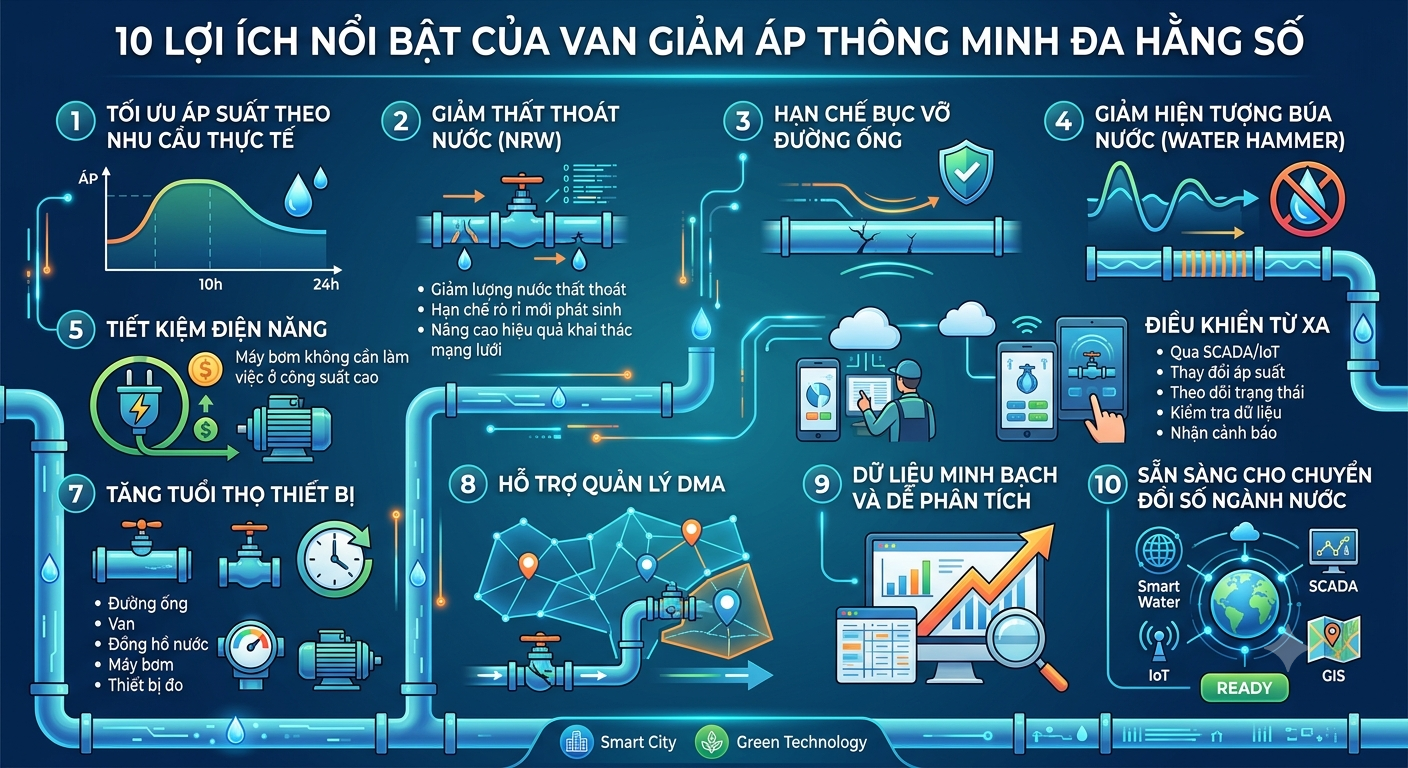
III. TEN KEY ADVANTAGES OF SMART MULTI-SETPOINT PRESSURE REDUCING VALVES
1. Pressure Optimization Based on Actual Demand
Rather than maintaining a constant outlet pressure, the valve automatically adjusts pressure according to real-time water demand, improving both operational efficiency and customer service.
2. Reduction of Non-Revenue Water (NRW)
Higher pressure directly increases leakage rates throughout aging water distribution systems.
By reducing pressure during low-demand periods, utilities can:
Minimize water leakage
Prevent new leaks from developing
Improve overall water conservation
Reduce operational losses
Pressure management is recognized worldwide as one of the most effective strategies for reducing Non-Revenue Water.
3. Protection Against Pipeline Failures
Excessive pressure fluctuations place continuous stress on pipelines and fittings.
Maintaining stable pressure significantly reduces the likelihood of:
Pipe bursts
Joint failures
Mechanical fatigue
Infrastructure deterioration
4. Reduction of Water Hammer
Gradual pressure adjustments eliminate sudden hydraulic shocks that may otherwise damage pipelines, valves, pumps, and water meters.
Smooth pressure modulation greatly enhances overall system reliability.
5. Energy Savings
Optimized pressure management reduces unnecessary pumping requirements.
Consequently:
Pump operating efficiency increases.
Electricity consumption decreases.
Operating costs are significantly reduced.
6. Remote Operation
Through SCADA or Industrial IoT platforms, operators can remotely:
Modify pressure setpoints
Monitor valve status
Access historical operating data
Receive real-time alarms
Diagnose system performance
This minimizes field visits while improving operational responsiveness.
7. Extended Equipment Life
Stable hydraulic conditions reduce mechanical stress on:
Pipelines
Pumps
Pressure reducing valves
Water meters
Instrumentation
As a result, maintenance frequency decreases while equipment lifespan is extended.
8. Ideal for District Metered Areas (DMA)
Smart Multi-Setpoint PRVs are particularly suitable for DMA pressure management because they enable independent pressure control within each hydraulic zone.
This improves leakage detection accuracy while supporting advanced pressure management strategies.
9. Comprehensive Operational Data
Every operating parameter—including pressure, flow, valve position, alarms, and historical trends—is continuously recorded.
These valuable datasets support:
Performance analysis
Water loss investigations
Predictive maintenance
Operational optimization
Regulatory reporting
10. Ready for Smart Water Digital Transformation
Smart Multi-Setpoint Pressure Reducing Valves are key components of modern Smart Water infrastructure.
They can seamlessly integrate with:
SCADA systems
IoT platforms
Geographic Information Systems (GIS)
Digital Asset Management Systems
AI-based operational optimization software
This makes them an essential technology for utilities pursuing digital transformation initiatives.
IV. COMPARISON BETWEEN CONVENTIONAL PRESSURE REDUCING VALVES AND SMART MULTI-SETPOINT PRESSURE REDUCING VALVES
Feature | Conventional PRV | Smart Multi-Setpoint PRV |
Pressure Setpoints | Single | Multiple |
Time-Based Pressure Control | No | Yes |
Flow-Based Pressure Control | No | Yes |
Inlet Pressure Compensation | No | Yes |
Remote Control | No | Yes |
SCADA Integration | No | Yes |
IoT Connectivity | No | Yes |
Historical Data Logging | No | Yes |
Alarm Notification | No | Yes |
Automatic Operation | Limited | Fully Automated |
DMA Compatibility | Basic | Excellent |
NRW Reduction Performance | Moderate | High |
Energy Efficiency | Standard | High |
Expandability | Limited | Highly Flexible |
Smart Water Compatibility | No | Yes |
Long-Term Operating Cost | Higher | Lower |
V. SMART MULTI-SETPOINT PRESSURE REDUCING VALVES: THE FUTURE OF WATER PRESSURE MANAGEMENT
As water utilities worldwide strive to reduce Non-Revenue Water (NRW), improve operational efficiency, enhance service reliability, and accelerate digital transformation, intelligent pressure management has become a strategic priority.
A Smart Multi-Setpoint Pressure Reducing Valve is far more than a pressure control device. It is an intelligent infrastructure component that enables utilities to optimize network pressure dynamically, reduce water losses, lower energy consumption, and extend the lifespan of critical assets.
Whether deployed in new construction projects or retrofitted into existing distribution networks, Smart Multi-Setpoint PRVs provide long-term technical, operational, and economic benefits.
As Smart Water initiatives continue to expand globally, these intelligent pressure management systems will play an increasingly important role in building safer, more efficient, and more sustainable water distribution networks.
RELATED ARTICLES
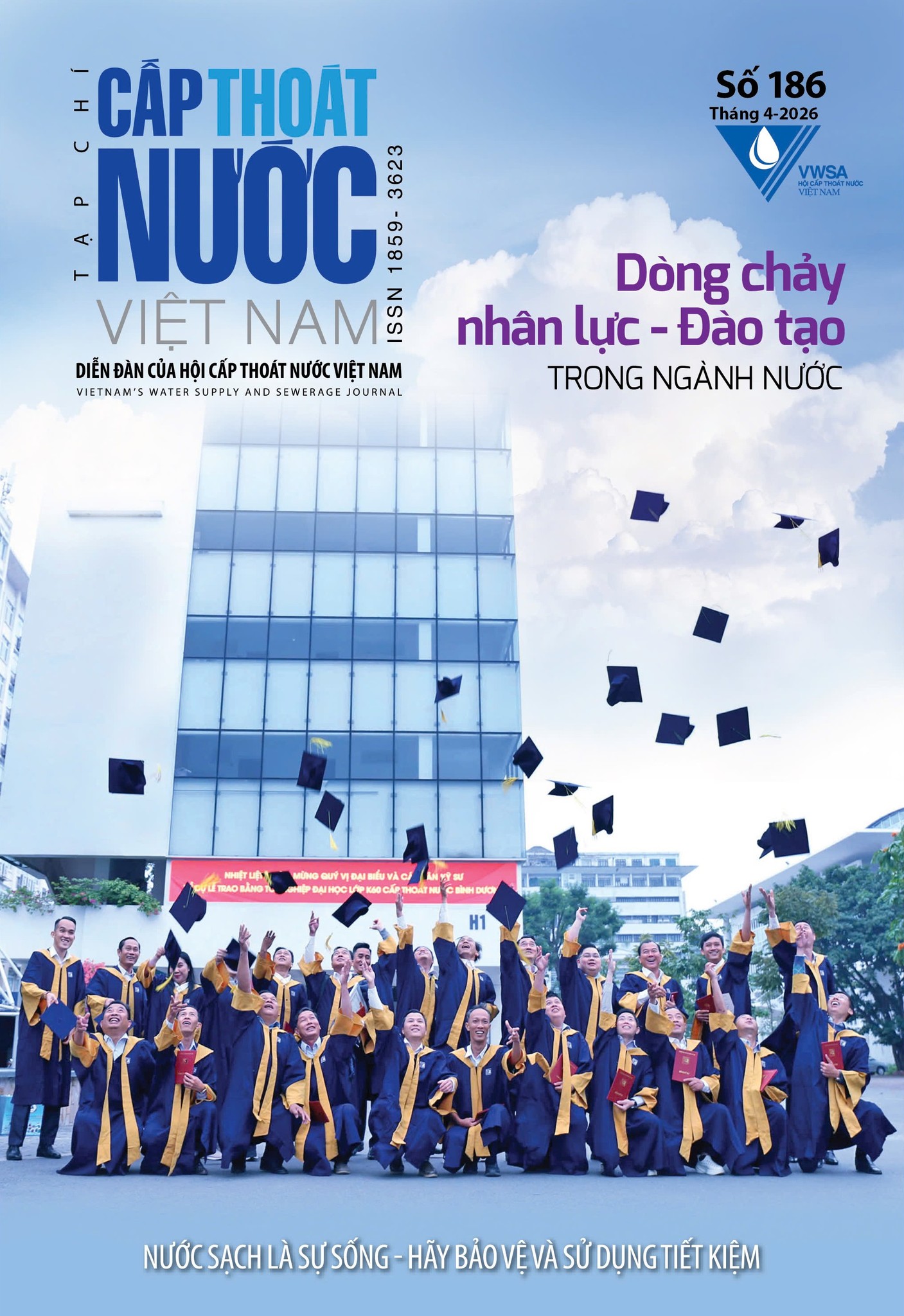
WATER INDUSTRY HUMAN RESOURCE MUST MOVE WITH TECHNOLOGY
SMART MULTI-SETPOINT PRESSURE REDUCING VALVE: THE INTELLIGENT PRESSURE CONTROL SOLUTION FOR MODERN WATER DISTRIBUTION SYSTEMS