WHAT IS SMART WATER? INTELLIGENT WATER MANAGEMENT SOLUTIONS | SAI GON VALVE
/what-is-smart-water
I. WHAT IS SMART WATER?
As climate change, rapid urbanization, and increasing water demand continue to place greater pressure on water resources, utilities are facing unprecedented challenges in maintaining reliable, efficient, and sustainable water supply systems. Traditional operating methods are no longer sufficient to meet today's requirements for operational efficiency, asset management, and customer service.
This has led to the emergence of Smart Water, a modern approach that is transforming the way water infrastructure is managed worldwide.
Smart Water refers to the integration of advanced digital technologies—including the Internet of Things (IoT), Supervisory Control and Data Acquisition (SCADA), Artificial Intelligence (AI), Big Data Analytics, Cloud Computing, and Geographic Information Systems (GIS)—to monitor, analyze, optimize, and control water infrastructure in real time.
Rather than relying solely on manual inspections and reactive maintenance, Smart Water enables utilities to make informed, data-driven decisions that improve operational performance, reduce water losses, enhance service reliability, and optimize resource utilization.
Today, Smart Water has become one of the key pillars of digital transformation for water utilities, municipalities, industrial facilities, and environmental management organizations worldwide.
II. HOW DOES SMART WATER DIFFER FROM TRADITIONAL WATER SUPPLY SYSTEMS?
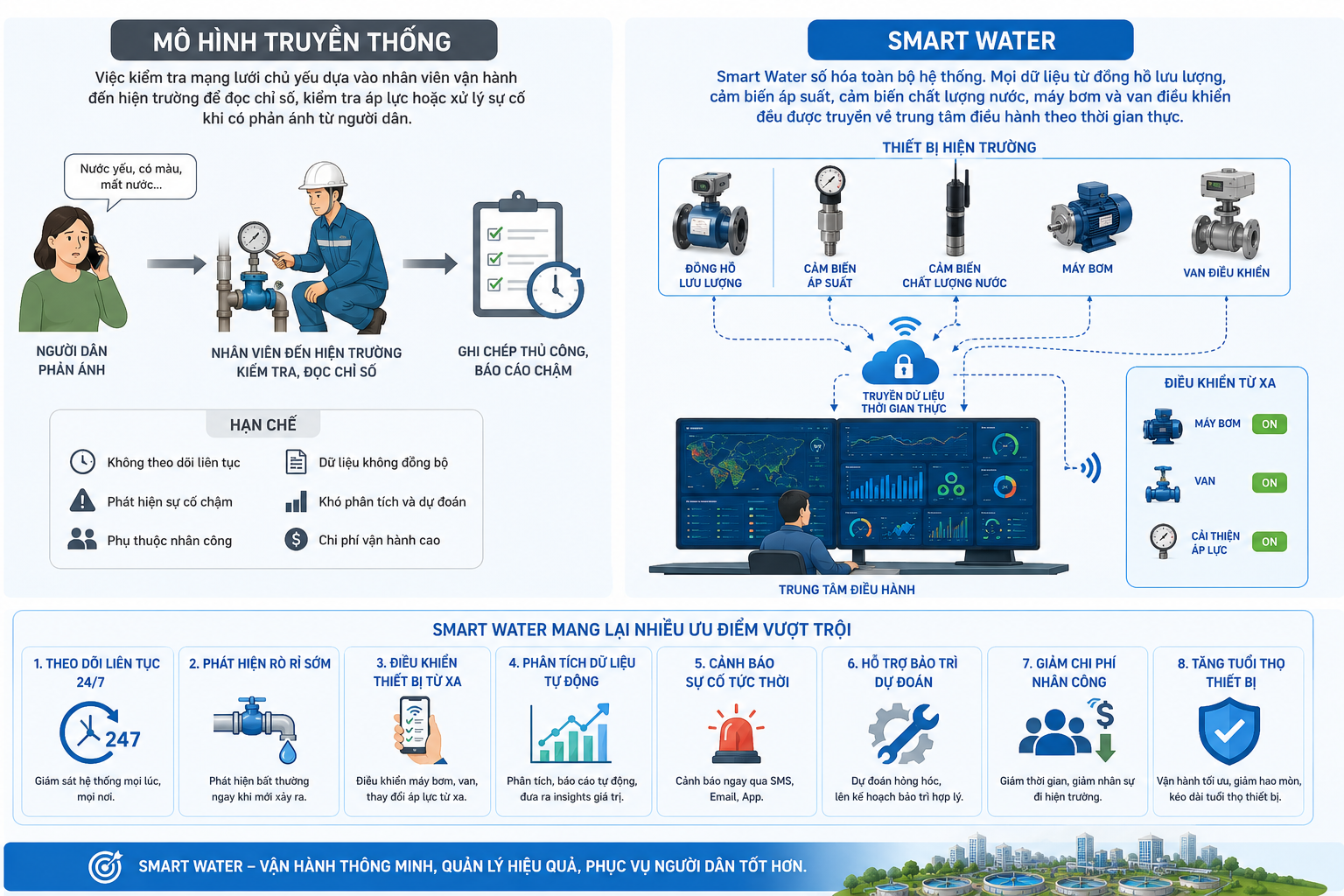
Conventional water distribution systems primarily depend on manual inspections, scheduled maintenance, and operator experience. Field technicians are required to visit pumping stations, reservoirs, pipelines, and monitoring locations to collect operational data and respond to issues after they occur.
Smart Water fundamentally changes this operational model by creating a fully connected and intelligent infrastructure.
Real-time information from flow meters, pressure sensors, water quality analyzers, pumping stations, smart control valves, and other field devices is continuously transmitted to a centralized monitoring platform.
Compared with traditional systems, Smart Water offers numerous advantages, including:
24/7 real-time monitoring
Early leak detection
Remote monitoring and control
Automated data collection
Intelligent alarm management
Predictive maintenance
Reduced labor costs
Improved asset reliability
Enhanced operational efficiency
Better customer service
III. CORE TECHNOLOGIES BEHIND SMART WATER
Internet of Things (IoT)
IoT serves as the technological backbone of Smart Water by connecting thousands of field devices—including sensors, flow meters, pressure transmitters, Data Loggers, and intelligent control valves—into a unified communication network.
Continuous data collection provides complete visibility into the operation of the water distribution system.
SCADA Systems
SCADA (Supervisory Control and Data Acquisition) enables centralized monitoring and remote control of water infrastructure.
Operators can visualize system status in real time, monitor historical trends, generate reports, manage alarms, and remotely control field equipment from a single control center.
Artificial Intelligence (AI)
Artificial Intelligence enhances operational efficiency by analyzing historical and real-time data to:
Detect abnormal operating conditions
Predict water demand
Identify hidden leaks
Optimize pressure management
Support predictive maintenance
Improve decision-making
Big Data Analytics
Modern Smart Water systems generate massive amounts of operational data every day.
Big Data Analytics transforms this information into valuable insights that help utilities optimize network performance, forecast consumption patterns, improve asset management, and support long-term planning.
Geographic Information Systems (GIS)
GIS provides a digital map of the entire water distribution network, displaying pipelines, valves, meters, pumping stations, reservoirs, and monitoring points.
This geographical visualization enables utilities to manage infrastructure assets more efficiently while improving maintenance planning and emergency response.
IV. KEY BENEFITS OF SMART WATER
Implementing Smart Water solutions provides substantial operational and financial benefits, including:
Reduced Non-Revenue Water (NRW)
Improved network reliability
Lower operating costs
Enhanced energy efficiency
Faster incident response
Optimized maintenance planning
Centralized asset management
Better regulatory compliance
Higher customer satisfaction
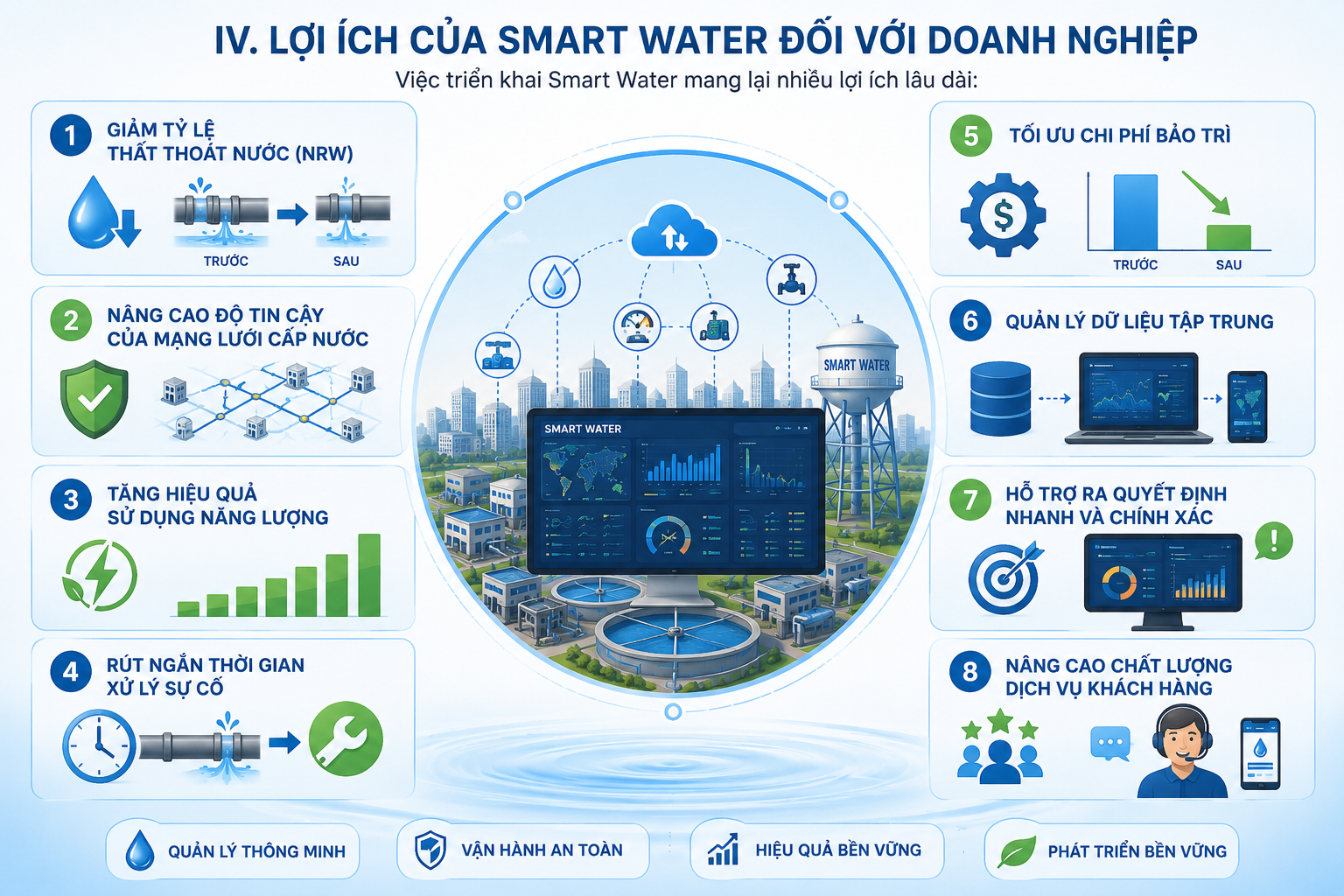
By transforming operational data into actionable intelligence, Smart Water helps organizations shift from reactive maintenance toward proactive infrastructure management.
V. SMART WATER AS A FOUNDATION FOR SMART CITIES
Smart Water is an essential component of modern Smart City initiatives.
By integrating water management with intelligent transportation, energy management, environmental monitoring, and digital infrastructure, Smart Water contributes to creating more sustainable and resilient urban environments.
Typical Smart City water applications include:
District Metered Area (DMA) management
Intelligent pressure management
Automated leak detection
Online water quality monitoring
Consumption analysis
Remote operation of pumping stations
Integrated emergency response systems
VI. SAI GON VALVE'S SMART WATER SOLUTIONS
Sai Gon Valve delivers comprehensive Smart Water solutions designed to meet the evolving needs of modern water utilities and industrial customers.
Our integrated solutions include:
Electromagnetic Flow Meters
Ultrasonic Flow Meters
SV1-DAQ Data Loggers
Pressure Monitoring Systems
Online Water Quality Monitoring Instruments
Electric and Pneumatic Control Valves
SCADA Integration
Web-Based and Mobile Dashboard Platforms
Remote Monitoring and Control Systems
IoT Data Integration and Analytics
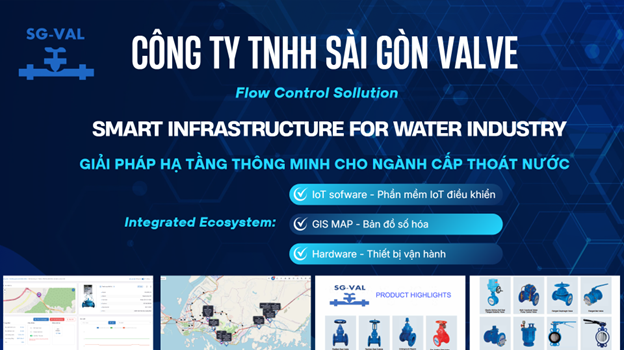
With extensive engineering expertise and project experience, Sai Gon Valve provides complete consulting, system design, equipment integration, installation, commissioning, and technical support tailored to each customer's operational requirements.
VII. FUTURE TRENDS IN SMART WATER
As digital transformation accelerates across the water sector, Smart Water technologies will continue to evolve through the integration of:
Artificial Intelligence (AI)
Machine Learning (ML)
Digital Twin Technology
Cloud Computing
Big Data Analytics
Geographic Information Systems (GIS)
Blockchain-based Data Security
These technologies will enable highly autonomous, data-driven water management systems capable of optimizing resource utilization, reducing operational costs, improving sustainability, and supporting long-term infrastructure resilience.
VIII. CONCLUSION
Smart Water represents far more than a technological advancement—it is a comprehensive transformation of how water infrastructure is managed in the digital age.
By combining IoT, SCADA, Artificial Intelligence, Big Data, and cloud-based technologies, Smart Water enables organizations to improve operational efficiency, reduce Non-Revenue Water, optimize maintenance strategies, strengthen infrastructure reliability, and deliver higher-quality water services.
For water utilities, municipalities, industrial facilities, and manufacturing enterprises, investing in Smart Water is a strategic decision that supports digital transformation, sustainable development, and long-term operational excellence.
As intelligent technologies continue to advance, Smart Water will play an increasingly critical role in building resilient, efficient, and sustainable water management systems for the future.
RELATED ARTICLES
WATER INDUSTRY HUMAN RESOURCE MUST MOVE WITH TECHNOLOGY
STRUCTURE, KEY BENEFITS, AND COMPARISON OF SMART MULTI-SETPOINT PRESSURE REDUCING VALVES