SMART MULTI-SETPOINT PRESSURE REDUCING VALVE: THE INTELLIGENT PRESSURE CONTROL SOLUTION FOR MODERN WATER DISTRIBUTION SYSTEMS
Discover how Smart Multi-Setpoint Pressure Reducing Valves optimize water pressure, reduce non-revenue water (NRW), protect pipeline infrastructure, and seamlessly integrate with SCADA and IoT systems. Learn more from Sai Gon Valve.
I. WHAT IS A SMART MULTI-SETPOINT PRESSURE REDUCING VALVE?
Pressure Reducing Valves (PRVs) have long been essential components in municipal water distribution systems, industrial facilities, water treatment plants, commercial buildings, and high-rise developments. Their primary function is to maintain a stable downstream pressure, protecting pipelines and downstream equipment from excessive pressure.
However, with the rapid advancement of digital transformation in the water industry, conventional mechanical PRVs are no longer sufficient to meet modern operational requirements.
Today's utilities face increasing challenges such as reducing Non-Revenue Water (NRW), improving energy efficiency, extending pipeline lifespan, and enabling centralized remote operation. Maintaining a single fixed outlet pressure throughout the day is no longer an optimal solution because water demand continuously fluctuates.
To address these challenges, the Smart Multi-Setpoint Pressure Reducing Valve has emerged as a next-generation pressure management solution.
Unlike traditional PRVs that maintain only one constant outlet pressure, a Smart Multi-Setpoint PRV can automatically switch between multiple preset pressure values according to real-time operating conditions, including:
Time schedules
Water demand patterns
Upstream pressure
Downstream pressure
Flow rate
SCADA commands
IoT platform data
Customized control algorithms
As a result, Smart Multi-Setpoint PRVs have become one of the key technologies supporting the development of modern Smart Water Networks.
II. WHY ARE CONVENTIONAL PRESSURE REDUCING VALVES NO LONGER ENOUGH?
Traditional pressure reducing valves were originally designed for systems where water demand remained relatively stable throughout the day.
Modern water distribution networks operate very differently.
Daily water consumption typically follows predictable demand patterns:
05:00 – 08:00: Morning peak demand
08:00 – 17:00: Moderate daytime consumption
17:00 – 22:00: Evening peak demand
22:00 – 05:00: Lowest nighttime demand
If a conventional PRV maintains the same downstream pressure throughout the entire day, several operational issues may occur:
Excessive pressure during low-demand periods
Increased leakage throughout the distribution network
Higher risk of pipeline bursts
Water hammer events caused by pressure fluctuations
Unnecessary energy consumption
Accelerated wear of valves, pumps, and pipeline infrastructure
These issues contribute significantly to water loss and increased operating costs.
Numerous studies within the water industry have shown that even a 1-bar reduction in average pressure can significantly decrease leakage rates while extending the service life of pipelines and hydraulic equipment.
Therefore, modern water utilities require intelligent pressure management solutions capable of adjusting pressure dynamically according to actual operating conditions rather than maintaining a single fixed pressure.
The Smart Multi-Setpoint Pressure Reducing Valve was specifically developed to fulfill this requirement.
III. WHAT IS A SMART MULTI-SETPOINT PRESSURE REDUCING VALVE?
A Smart Multi-Setpoint Pressure Reducing Valve is an electronically controlled pressure management system that combines a hydraulic pressure reducing valve with intelligent control technologies.
Instead of operating with only one downstream pressure setting like conventional PRVs, the system can store multiple pressure setpoints and automatically switch between them according to predefined operating strategies.
For example:
Time Schedule | Outlet Pressure |
|---|---|
05:00 – 08:00 | 4.2 bar |
08:00 – 17:00 | 3.5 bar |
17:00 – 22:00 | 4.5 bar |
22:00 – 05:00 | 2.8 bar |
The valve automatically adjusts its outlet pressure at each scheduled period without requiring manual intervention.
More advanced systems can also modify outlet pressure based on:
Instantaneous flow rate
Upstream pressure
Downstream pressure
Reservoir water level
Pump operating status
Leakage detection signals
Remote SCADA commands
IoT-based optimization strategies
By continuously adapting to actual network conditions, the valve ensures that water pressure remains optimized at all times.
IV. WHY IS IT CALLED A "MULTI-SETPOINT" PRESSURE REDUCING VALVE?
The term "Multi-Setpoint" refers to the valve's ability to store and automatically operate with multiple pressure setpoints instead of a single fixed pressure.
Conventional pressure reducing valves typically allow only one pressure setting, which remains unchanged until manually adjusted.
In contrast, Smart Multi-Setpoint PRVs can automatically switch between different operating modes, including:
Peak demand mode
Off-peak mode
Night pressure reduction mode
Dry season operation
Rainy season operation
Emergency water supply mode
Maintenance mode
District Metered Area (DMA) operation
These pressure profiles can be activated automatically according to scheduled programs or dynamically through commands received from a centralized SCADA system.
This intelligent capability represents one of the most significant technological advancements over conventional mechanical pressure reducing valves.
V. WORKING PRINCIPLE OF A SMART MULTI-SETPOINT PRESSURE REDUCING VALVE
A Smart Multi-Setpoint Pressure Reducing Valve operates through the integration of hydraulic control and intelligent automation technologies.
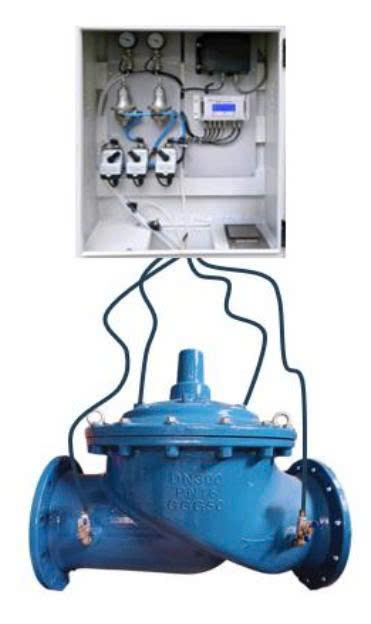
The system generally consists of:
Pressure sensors
Flow meters
PLC or intelligent controller
Main control valve
Pilot valve
Electric or electro-hydraulic actuator
SCADA platform
IoT gateway
Cloud-based monitoring software
The operating sequence typically follows these steps:
Step 1 – Data Acquisition
Pressure sensors and flow meters continuously collect real-time operational data from the water distribution network.
Step 2 – Intelligent Analysis
The controller compares the measured values with the predefined pressure setpoint currently in operation.
Step 3 – Automatic Calculation
Whenever deviations are detected, the controller calculates the optimal valve position required to restore the desired outlet pressure.
Step 4 – Valve Adjustment
The control signal is transmitted to the electric actuator, which precisely adjusts the valve opening to achieve the target pressure.
Step 5 – Continuous Feedback Control
The entire process operates continuously in a closed-loop control system, allowing the valve to respond immediately to changing flow conditions while maintaining highly stable downstream pressure.
VI. ADVANCED TECHNOLOGIES INTEGRATED INTO SMART MULTI-SETPOINT PRVS
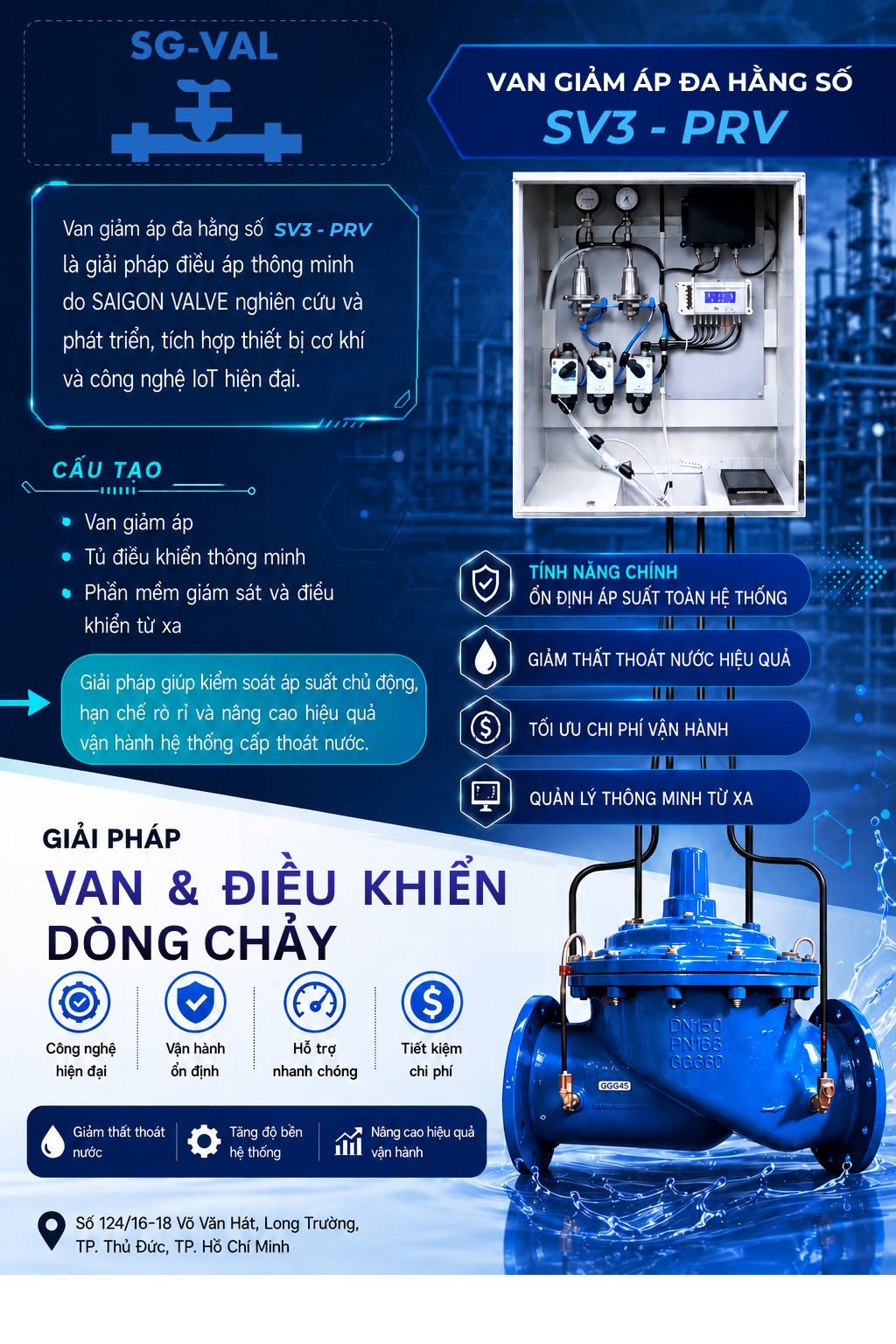
A Smart Multi-Setpoint Pressure Reducing Valve is far more than a mechanical valve. It represents the integration of hydraulic engineering, industrial automation, and digital technologies.
Typical integrated technologies include:
PID intelligent pressure control
High-precision electric actuators
PLC-based automation
SCADA integration
IoT remote monitoring
Cloud-based data management
Historical data logging
Real-time alarm notifications
Predictive maintenance capabilities
Compatibility with Smart Water platforms
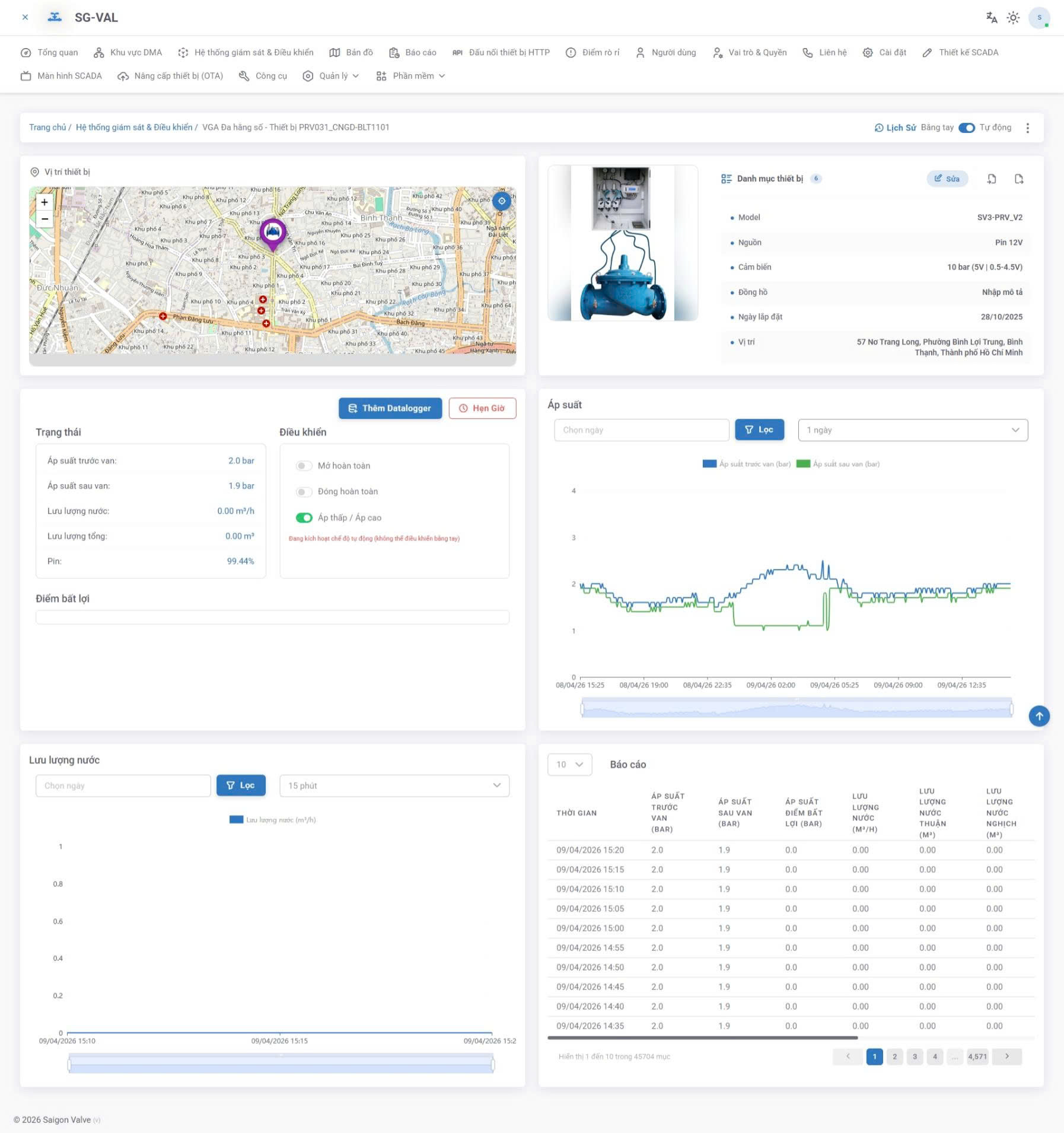
By combining these technologies, the Smart Multi-Setpoint Pressure Reducing Valve not only regulates pressure but also becomes a critical component of intelligent water distribution management systems, helping utilities improve operational efficiency, reduce water losses, and support digital transformation initiatives.
RELATED ARTICLES
WATER INDUSTRY HUMAN RESOURCE MUST MOVE WITH TECHNOLOGY
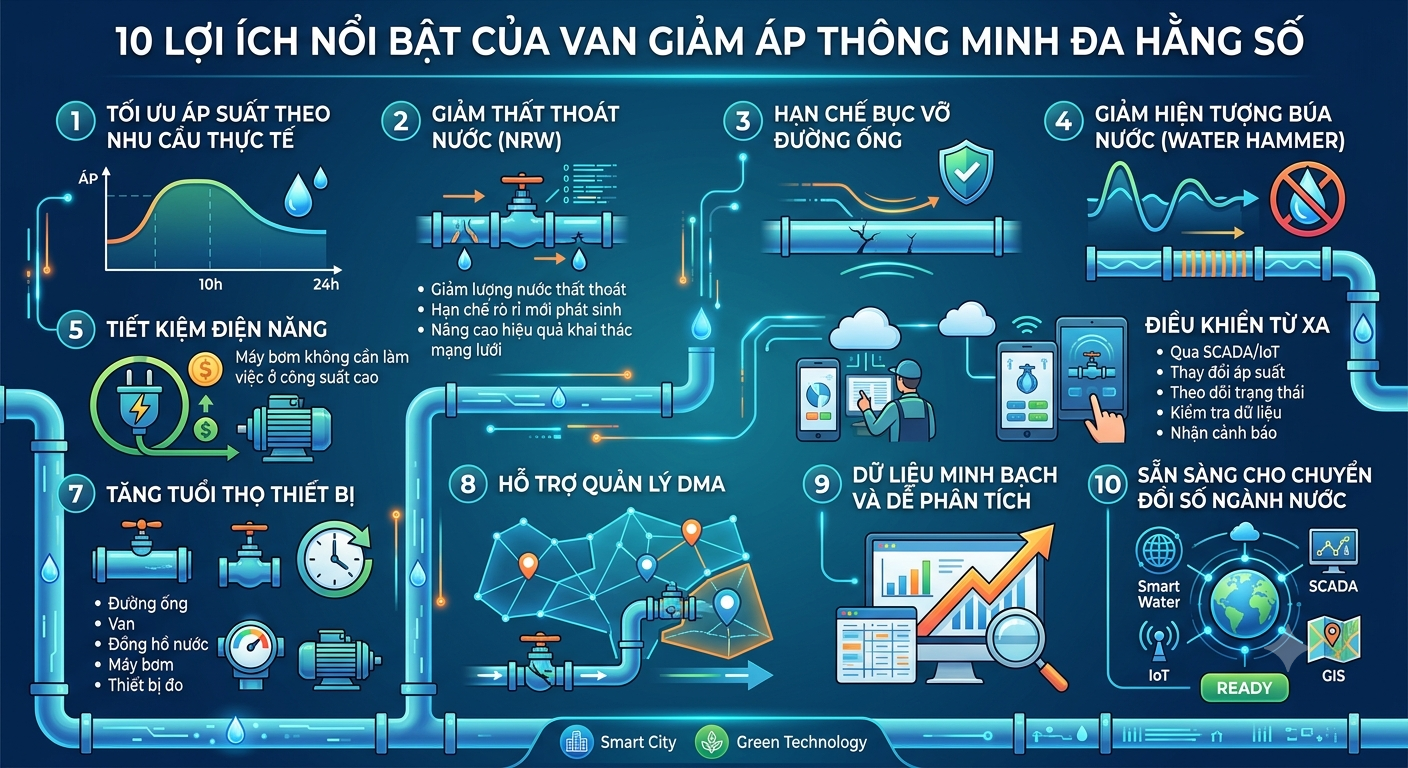
STRUCTURE, KEY BENEFITS, AND COMPARISON OF SMART MULTI-SETPOINT PRESSURE REDUCING VALVES